#11: Learning Handwritten Digits with AI
Project Overview
The National Institute of Standards and Technology (NIST), an institute run by the government of the United States, provides a collection of "Special Databases" that "contain digital data objects such as images, software, and videos" and can be found at https://www.nist.gov/srd/related-data-products-and-links/special-databases-and-special-software. Two specific early "Special Databases" have become some of the most famous datasets in machine learning and artificial intelligence:
- SD-3 contains handwriting samples from 2,100 United States census workers during the 1990 census.
- SD-7 contains handwriting samples from 500 high school students in Maryland.
As part of the 1992 paper "Comparison of classifier methods: a case study in handwritten digit recognition" by Léon Bottou et al., the authors describe the creation of the "Modified NIST" (MNIST) dataset that:
- Included samples from 500 unique writers (250 from each NIST dataset), and
- Normalized all images to 28×28 pixel gray scale images
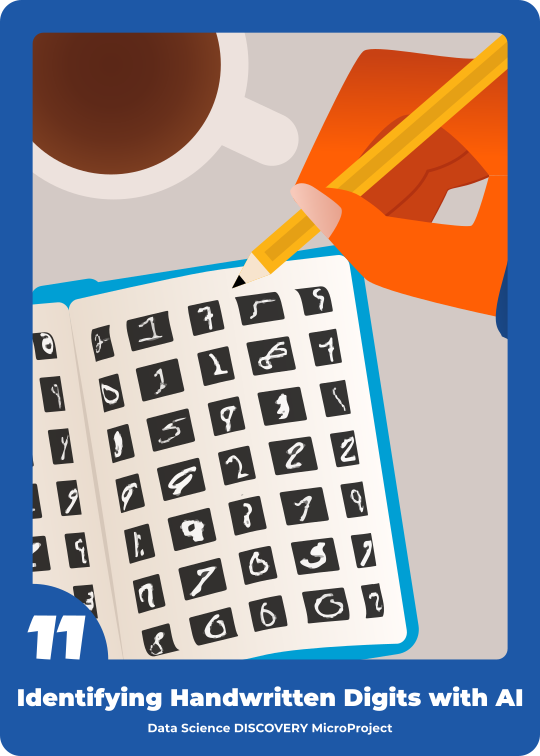
This MNIST dataset is now one of the most famous datasets in machine learning and artificial intelligence. This dataset contains a collection of 70,000 images of hand-written digits and each are labeled with the number (ex: a picture of a "0" and labeled as 0). In this project, you'll explore the MNIST dataset and learn about various clustering algorithms to help a computer learn to recognize handwritten digits. Let's nerd out! 🎉
Getting Started
This project is completed in your browser using Python!